Restoration Local SEO Marketing: A Practical Playbook for Local Search Visibility

5 min read
When a pipe bursts at 11pm, the homeowner isn't asking neighbors for recommendations or waiting until morning to call their insurance agent. They're opening Google and typing something like "water damage restoration near me." Whether your business shows up in that moment (or a competitor's does) depends largely on one thing you can control: how well you've built your local search presence.
This guide is a practical playbook for restoration contractors who want to understand local Search Engine Optimization (local SEO), build it right, and keep it working without adding a full-time marketing role to their overhead.
Before we get into tactics, though, there's a question worth addressing.
Is SEO even relevant anymore? Isn't everyone using AI now?
The short answer is: both things are true, and they're not in conflict.
AI tools like ChatGPT and Google's AI Overviews are changing how people search. But those AI systems still rely heavily on search engine data to generate their answers. Research from Nectiv found that prompts with local intent trigger a live web search in nearly 60% of cases, meaning the AI pulls results from Google before responding. And according to Sparktoro, 95% of Americans still use traditional search engines monthly, even as AI adoption grows. SEO strategist Lily Ray has put it plainly: large language models (LLMs) are highly reliant on up-to-date search data, so one of the best ways to show up in AI answers is to have solid SEO and strong brand visibility to begin with.
In other words, the same work that improves your local rankings also improves how AI tools surface your business. The foundation is the same either way.
Should I Just Hire an Agency to Run My SEO or Do It Myself?
The honest answer is that it depends on where you are in your growth.
If you're in the early stages of building your company, SEO is not going to be an immediate growth driver. The timeline is slow, competition in most markets is real, and the payoff compounds over years, not weeks. The right move early on is to get the basics in place:
- a verified Google Business Profile and Bing Places
- an easy to use website that lists your location and services, and
- a handful of citations, meaning consistent listings of your business name, address, and phone number on directories like Yelp, Angi, and the Better Business Bureau.
Then, focus your lead generation energy elsewhere while SEO builds in the background.
If you're an established company with cash flow and a real service area, a good SEO agency can accelerate your visibility significantly. The operative word is "good."
If you're still building your overall marketing strategy, it's worth reviewing the full range of marketing approaches available to restoration businesses before going deep on any single channel.
What to Look for in a Local SEO Agency
Finding the right SEO partner takes some due diligence. Here's what to look for:
- SEO is their primary service, not an add-on to web design or social media. It should be how they keep the lights on.
- They have existing customers you can actually call, not just testimonials on a page.
- Ask how long they typically retain clients; high churn is a red flag.
- They're willing to explain their process in plain language, not hide behind jargon.
- They don't promise results or claim a special relationship with Google. Anyone who guarantees visibility is either lying or about to do something that will eventually hurt you.
- They insist that they maintain full ownership of your domain, hosting account, Google Analytics, Google Search Console, and any other accounts they work in. You should always have control over your own assets.
Local SEO typically involves two phases: an upfront investment to get the foundation right, followed by ongoing maintenance—monthly reporting, review monitoring, and making adjustments as your rankings develop. Pricing varies widely depending on the scope, market, and provider. What's consistent is that quality work costs real money, and providers offering unusually low rates rarely have the expertise or bandwidth to do this well. Get multiple quotes, ask what's actually included in each phase, and be skeptical of any agency that can't explain their work in plain language.
If you're technically-minded, patient with a steep learning curve, and willing to invest the time, the DIY path is also a legitimate option for getting your foundation in place.
The Restoration Local SEO Foundation
Here's where to start if you're taking local SEO under your own wing.
Step 1: Dial in Your Local Signals: NAP (Name, Address, Phone) + Service Areas + Site Structure
Local search rankings depend in part on how close your business is to the person searching, and how consistently your information appears across the web. The first thing to get right is your NAP (Name, Address, and Phone) and to make sure it's identical across your website, Google Business Profile, directories, and social profiles. Even small inconsistencies and typos (Suite 100 vs. Ste. 100) can create confusion in how search engines index your location data.
Do you need a listed address? Yes, if you want to appear in Map Pack results. The Map Pack is the block of three local business listings Google displays above the regular search results—it's one of the most visible spots in local search, and it's driven heavily by proximity to the searcher's location.
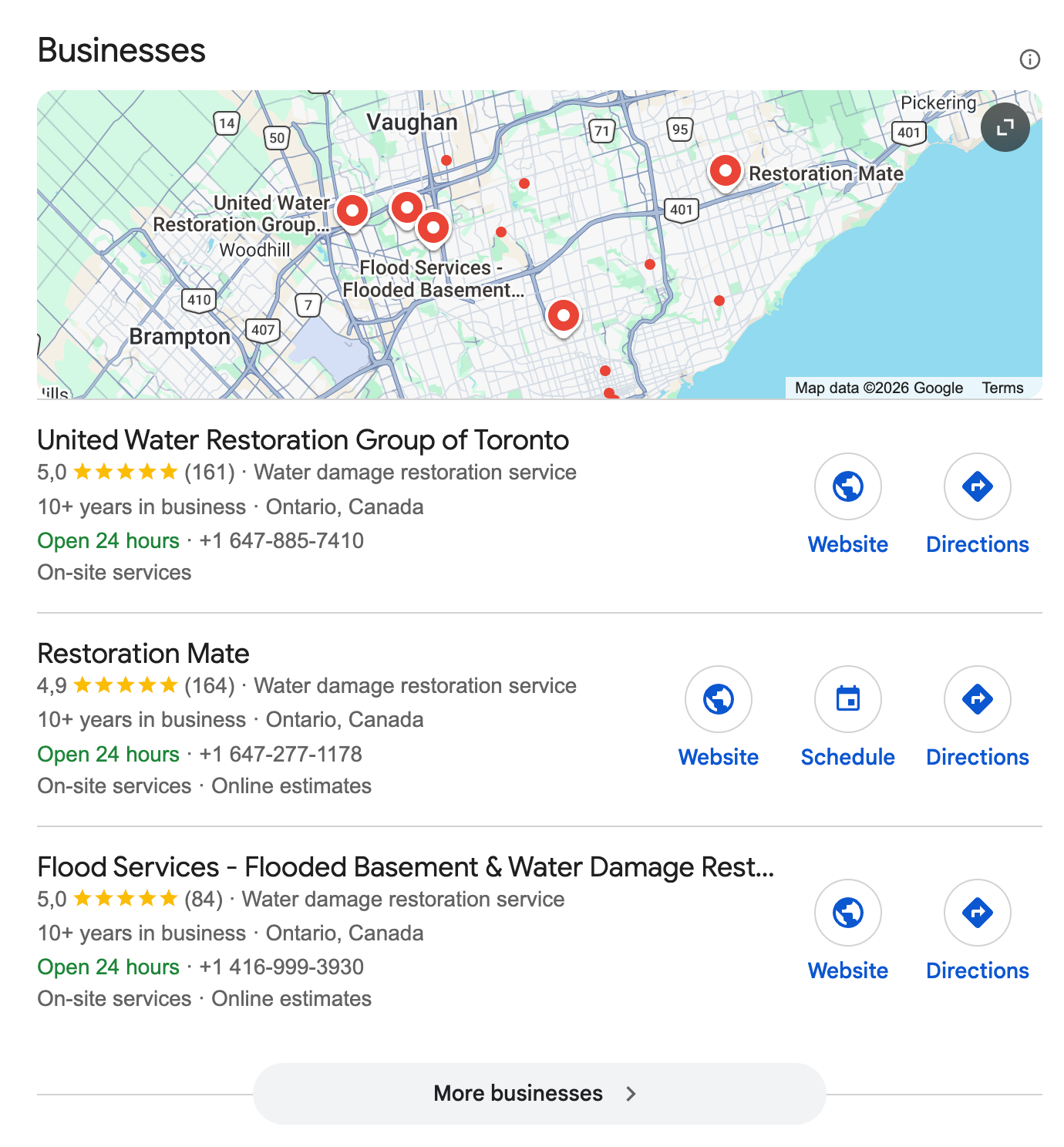
Google requires a verifiable business address to show your listing there. This creates a real challenge for service area businesses: if your listed address is in one city but you serve three surrounding counties, you'll likely rank well near your address and less well at the edges of your territory.
If you operate meaningful, ongoing work in a secondary market, a separate verified address in that area—whether a second office, a partner location, or a legitimate registered address—gives you a second Map Pack anchor. This isn't a workaround; it's how multi-location businesses are designed to work in Google's system. The address doesn't have to be a traditional office, but it does need to be a real, consistent address Google can confirm.
Step 2: Make Your Website Conversion-Ready for Emergency Searches
People who search for restoration services in a crisis move fast. Your website needs to match that pace.
Above the fold (the part of the page visible before someone scrolls), you need: a tap-to-call button, a clear statement of your availability (24/7 if true), an honest response time, and trust signals like certifications or review ratings. Below that, a brief process overview covering first contact, dispatch, inspection, estimate, and approval does a lot to reduce the hesitation that costs you jobs.
Page speed—how quickly your website loads on a phone or computer—matters especially for restoration, where a distressed homeowner won't wait for a slow site to load before moving on to the next result. If you notice your load time is slow, you can ask your web developer to prioritize site speed or, if you're managing your own website, you can start by making sure any images on your site are an appropriate size.
For each service area you want to target, consider publishing a dedicated landing page targeting "emergency restoration services in Atlanta." Each page should include the same core elements as your main service pages—what you offer, who you serve, how to reach you—but written for that specific area. That means referencing the city or region by name, speaking to local risks where relevant (coastal flooding, freeze events, wildfire proximity), and embedding the local phone number or service area address if you have one.
The goal is a page that feels genuinely written for someone in Atlanta, not a copy-paste with the city name swapped in. These pages work both for search rankings and for giving local customers something that feels relevant to where they are.
Local SEO Strategies for Restoration Companies
1. Google Business Profile Optimization (Map Pack Focus)
The Map Pack is the block of three local businesses Google shows at the top of search results, with a map, ratings, and phone numbers. It's prime real estate, and Google Business Profile (GBP) optimization is the primary way to earn a spot in it.
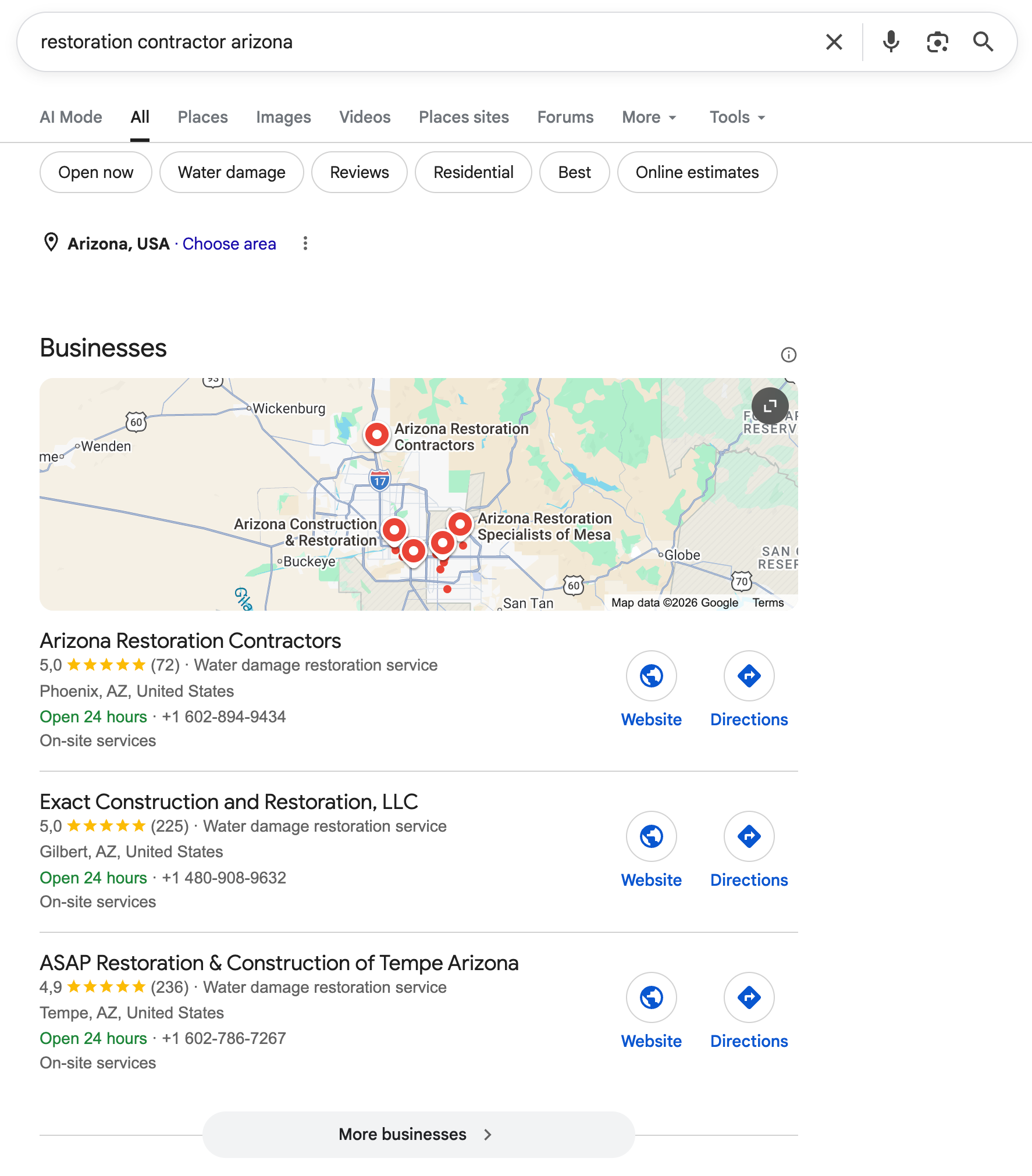
Your Google Business Profile is likely the first thing a potential customer sees after searching for your services. It's also where word-of-mouth referrals go to verify you're legitimate before they call, which makes it one of the highest-value pieces of your digital presence.
Keep everything current. Choose a primary category that accurately reflects your core service (Restoration Service, Water Damage Restoration Service, etc.), and add secondary categories for the other services you offer. Write service descriptions that use the language your customers actually search: "water damage restoration," "emergency water removal," "mold remediation," "fire damage cleanup."
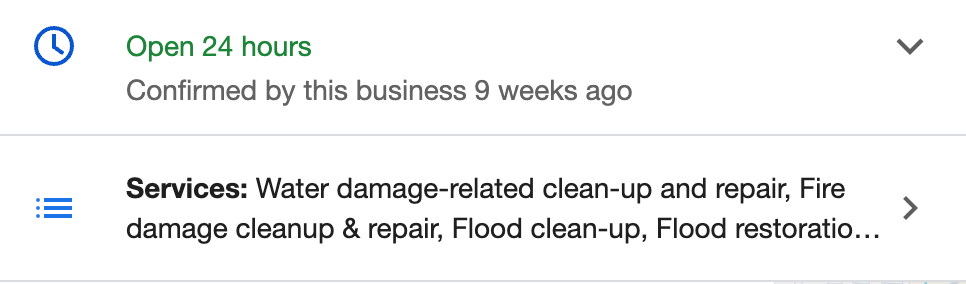
Weekly proof posts—meaning short posts to your Google Business Profile showing recent job photos, completed projects, or brief updates about work in your service area—signal to Google that your business is active and relevant. Think of it like keeping a public record of your work, one job at a time.
For example: a photo of a dried-out crawl space with a caption noting the city and what caused the damage. A before-and-after of a fire-damaged room with a one-sentence update on timeline. A short note that your crew completed a mold remediation job in a specific neighborhood that week. None of these need to be polished—they just need to be consistent and location-specific.
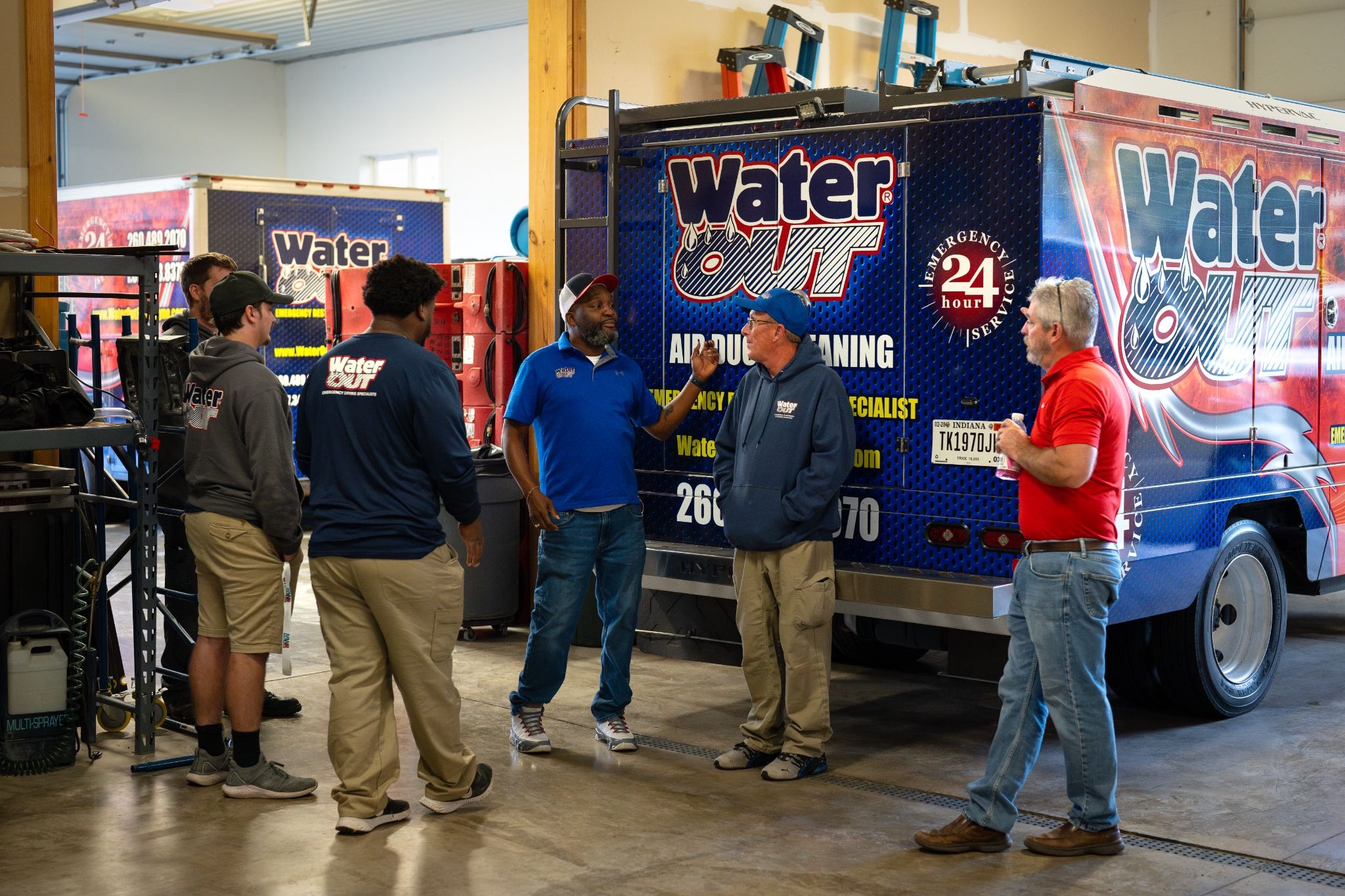
Photos should include job documentation (before/during/after where appropriate), equipment, your team, and trucks. The Google Business Profile Q&A section is also worth seeding with the questions your callers actually ask: Does insurance cover this? Are you available tonight? How long does mitigation take?
2. Location and Service Pages That Don't Feel Like SEO Spam
Your Google listing is one piece of local visibility. The other lives on your own website, in the individual pages you build for each service and service area — your service pages and local pages.
The goal with these pages isn't to stuff keywords onto a page and replicate it across every city you serve. It's to build something a homeowner in that area would actually find useful.
A service page is a dedicated page on your website for a specific type of work you do (water damage mitigation, fire restoration, mold remediation). A location page targets a specific city or area you serve, so a homeowner in a neighboring town can find you even if your office isn't physically there. Together, these two page types do most of the heavy lifting for local search visibility beyond your Google Business Profile.
Build around real demand patterns: a core service page for each major service (water damage, fire damage, mold remediation) that explains your process and answers common questions, location pages for the areas you serve that include local proof (reviews mentioning that area, job stories from that neighborhood, local partner mentions) and service-in-location combinations only where you have the work history to back them up.
Each local page should pass a basic uniqueness check:
- Does it include local testimonials?
- A job story or mini case study from that area?
- Photos tied to real jobs, not stock imagery?
If the answer is no to all three, you may want to consider getting those forms of content on your local pages.
3. Restoration Review Engine
Reviews are among the most influential factors in local search rankings, and they're also one of the hardest things to build without a deliberate process.
The best time to ask for a review is right after job completion, when the homeowner has seen the results and is satisfied. Don't script what they say, guide them toward specificity instead. Customers who mention the service performed, the area, and the outcome leave reviews that signal relevance to search engines and build trust with future customers.
Respond to every review. For positive reviews, acknowledge the specific job and thank them. For negative ones, respond calmly, acknowledge the concern, and offer to resolve it offline. A business that responds to negative feedback professionally often comes across as more trustworthy than one with a perfect record and no responses.
Avoid review gating, asking customers if they're satisfied before deciding whether to request a review, as this violates Google's policies.
4. Local Authority: Citations, Partnerships, and Links That Actually Matter
Google uses mentions and links to your website as trust and authority signals. For local businesses, this includes both structured citations (business directory listings that include your Name, Address, and Phone) and unstructured mentions (links to your website like a local news article mentioning your company or a partner's website linking to yours).
Start with high-quality citations in major directories and restoration-specific listings. Then build partnerships with businesses that work adjacent to yours: plumbers, roofers, property managers, insurance brokers, and local chambers of commerce. A mutual referral relationship often comes with a website mention that helps your local authority over time.
Sponsoring local events, contributing to community organizations, or doing something genuinely visible in your market can earn local press coverage. Even a brand mention without a link may contribute to how search engines and AI tools understand your business's local relevance, though the extent of this effect is still debated among SEO practitioners. Consider using a tool like WhiteSpark's Local Citation Finder to identify citation sources specific to your area.
5. Content That Matches Emergency Intent
A blog for a restoration company doesn't need to generate direct leads to be worth publishing. Think of blog content as resources that demonstrate how you work and quietly establish you as the company in your market that actually explains things.
A few content ideas to explore:
- What to do in the first hour after a pipe bursts (or a fire, or a flood)
- Will insurance cover water damage from [specific scenario]?
- How long does mitigation actually take, and what happens during it?
- What homeowners in [your area] need to know about [seasonal risk]
The goal with each piece is to answer the question a real customer is already searching for, in plain language, in a way that reflects how your company actually works.
A sustainable cadence looks different for every team based on their size and available resources. A good start leans into tracking customer wins, building case studies when you can and repurposing those into content for your Google Business Profile each month.
Restoration Company SEO Lead Generation: Turning Visibility Into Calls
Local SEO Is One Part of Your Search Presence
When someone searches for a restoration contractor, multiple things can show up before they ever reach your website: paid ads, a map listing, a Google-screened badge, and organic results. Understanding what each of these is helps you make smarter decisions about where to invest.
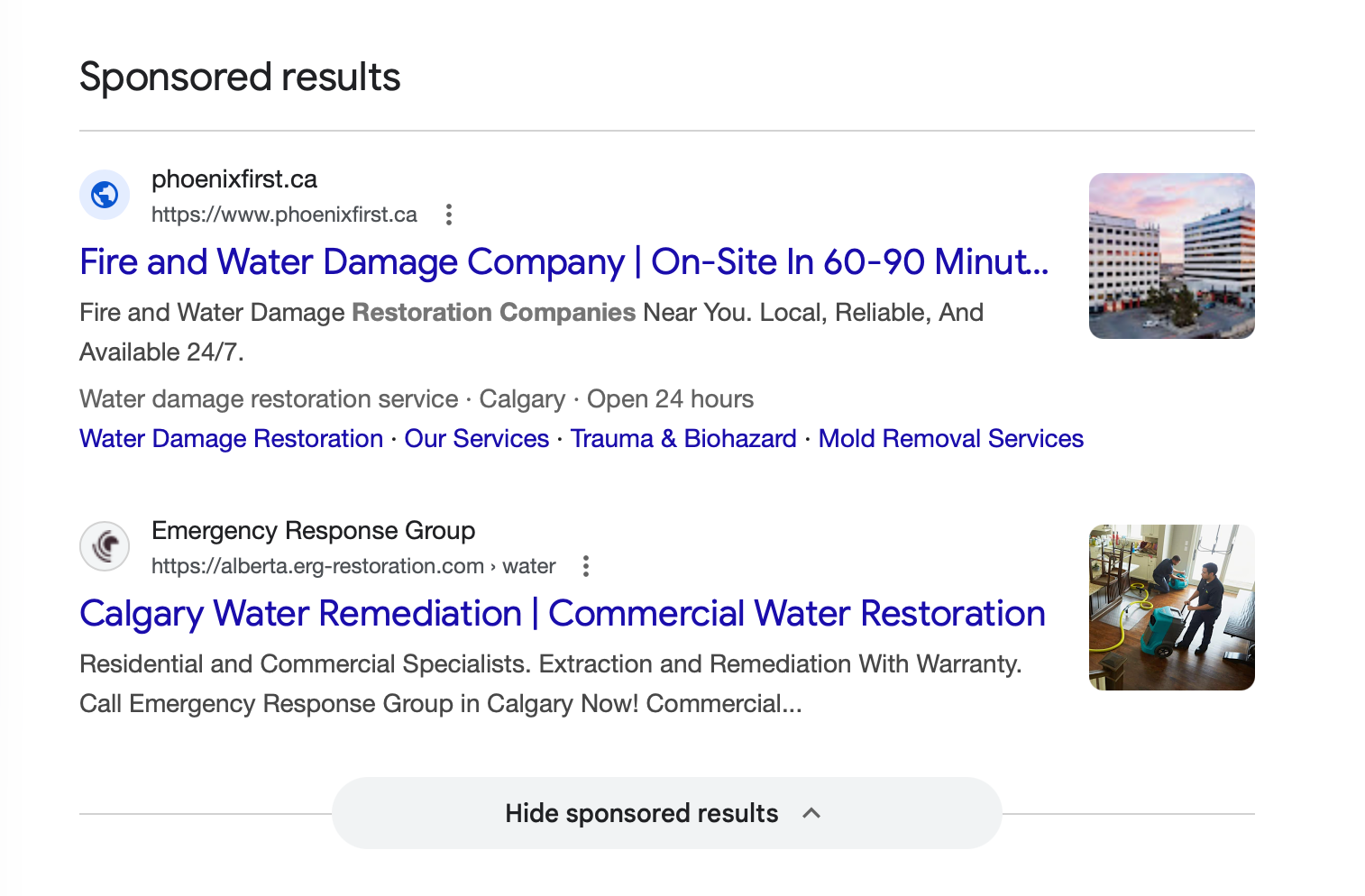
Paid search ads (sometimes called PPC, or pay-per-click) are the listings that appear at the very top of Google results, marked with a small "Sponsored" label. You pay each time someone clicks. They can generate calls quickly, but the moment you stop paying, they disappear.
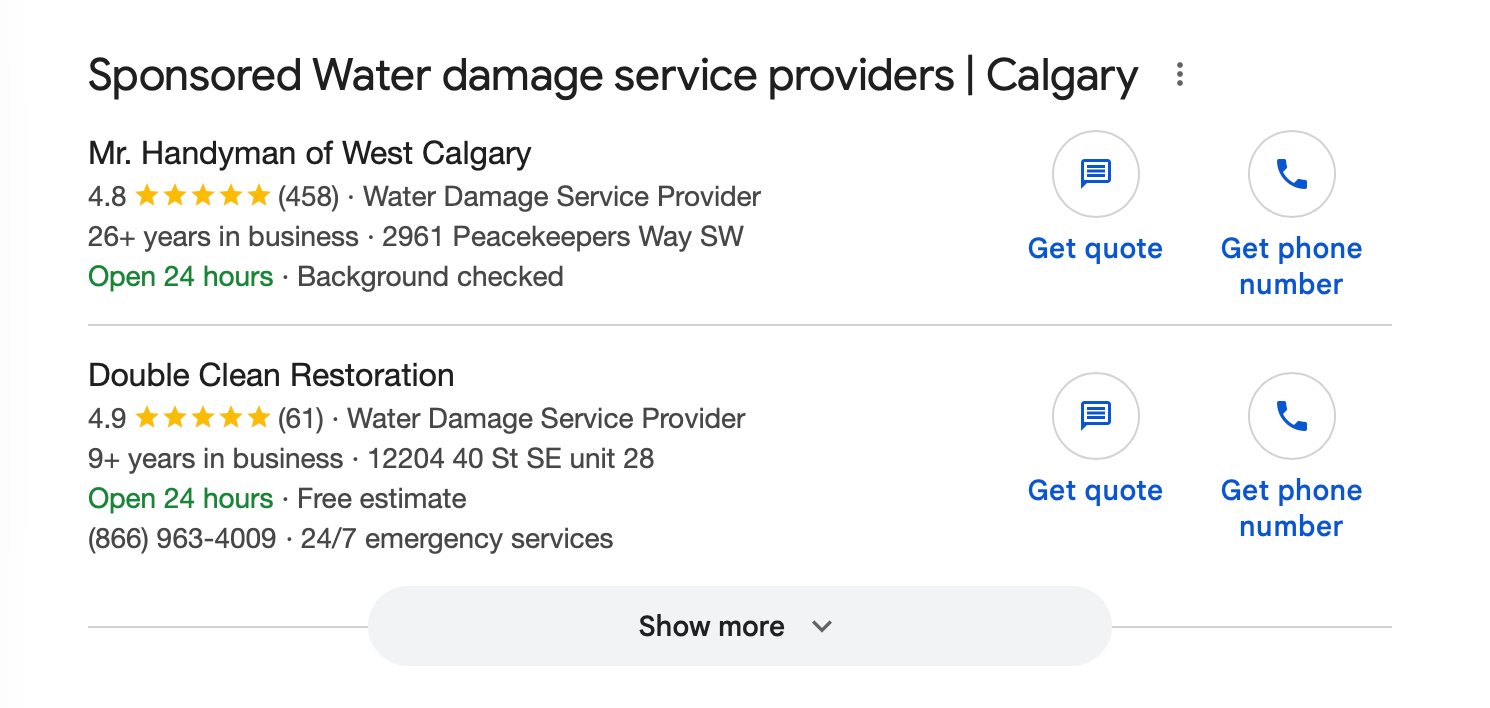
Local Service Ads (LSAs) are a separate Google product specifically designed for service businesses like restoration contractors. They appear above regular ads, include your reviews and a Google-screened badge (which signals that Google has verified your license and background), and you pay per lead rather than per click. For restoration, they're worth understanding because the badge carries real credibility with homeowners who don't know who to trust after a loss.
Organic Listings—what this guide covers—is the unpaid side. It compounds over time. The more consistently you build it, the more cost-efficient it becomes as a lead source.
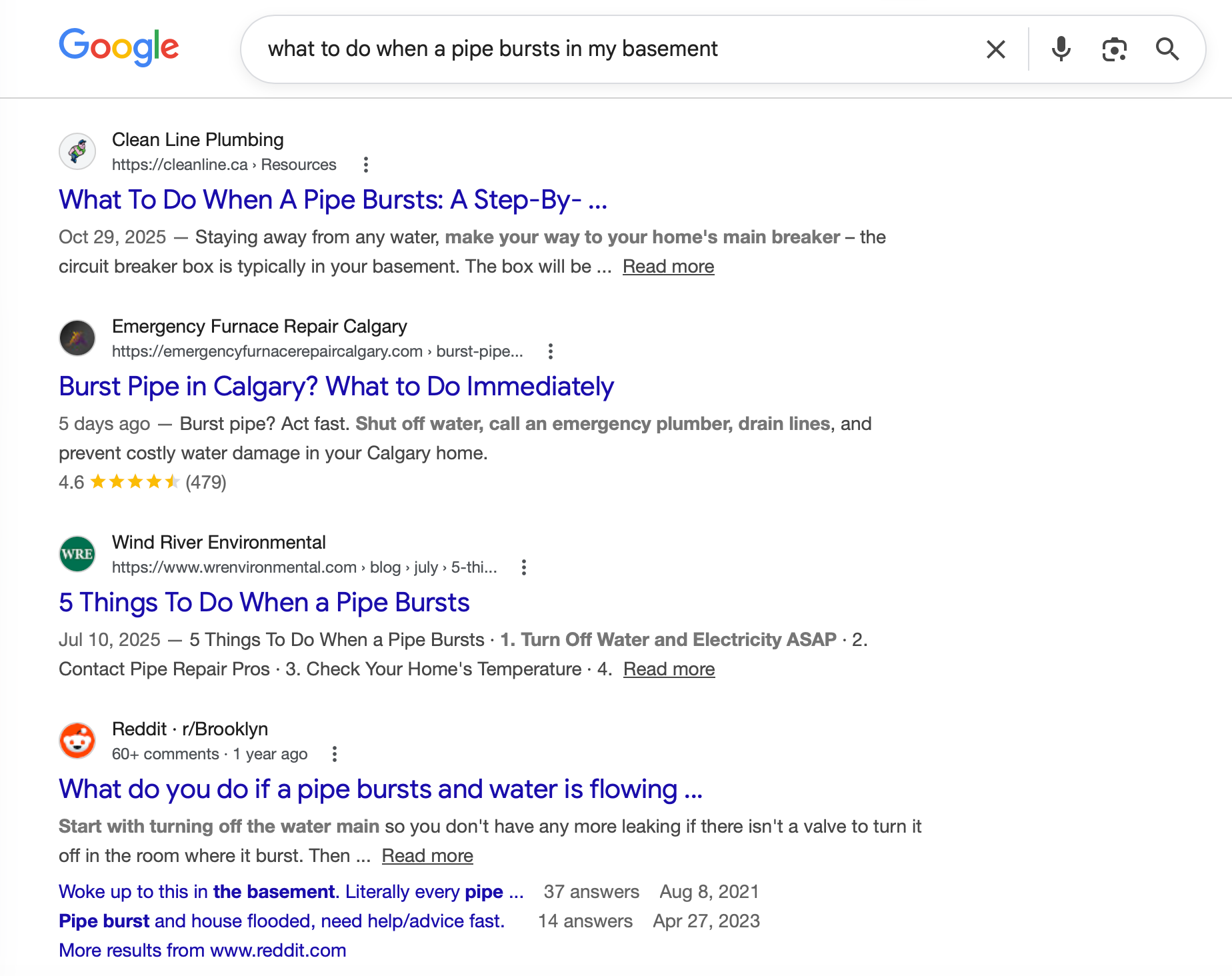
Running paid ads while your local SEO develops is smart sequencing. They serve different timeframes: ads work now, SEO builds toward something more durable. The mistake is treating them as either/or, or neglecting your organic presence entirely while chasing short-term paid volume.
One more thing worth protecting: your branded search. If someone already knows your name and searches it directly, your Google Business Profile and website should be polished enough to close that lead. A neglected listing or a slow website can cost you a call that was already yours.
The Long Game Is the Right Game
Local SEO doesn't reward urgency. It rewards consistency, quality documentation, and genuine relevance to the communities you serve.
The contractors who build lasting visibility in their markets share a common pattern: they treat every job as an opportunity to demonstrate their process, they build relationships that translate into links and mentions over time, and they create content that helps homeowners and property managers understand what good restoration work looks like before the emergency happens.
Done consistently, that work earns visibility and builds customer confidence before anyone picks up the phone. Now that you’ve set up the local SEO foundation, you may want to review our guide on how to operationalize and track your marketing efforts to improve performance.
When a pipe bursts at 11pm, the homeowner isn't asking neighbors for recommendations or waiting until morning to call their insurance agent. They're opening Google and typing something like "water damage restoration near me." Whether your business shows up in that moment (or a competitor's does) depends largely on one thing you can control: how well you've built your local search presence.
This guide is a practical playbook for restoration contractors who want to understand local Search Engine Optimization (local SEO), build it right, and keep it working without adding a full-time marketing role to their overhead.
Before we get into tactics, though, there's a question worth addressing.
Is SEO even relevant anymore? Isn't everyone using AI now?
The short answer is: both things are true, and they're not in conflict.
AI tools like ChatGPT and Google's AI Overviews are changing how people search. But those AI systems still rely heavily on search engine data to generate their answers. Research from Nectiv found that prompts with local intent trigger a live web search in nearly 60% of cases, meaning the AI pulls results from Google before responding. And according to Sparktoro, 95% of Americans still use traditional search engines monthly, even as AI adoption grows. SEO strategist Lily Ray has put it plainly: large language models (LLMs) are highly reliant on up-to-date search data, so one of the best ways to show up in AI answers is to have solid SEO and strong brand visibility to begin with.
In other words, the same work that improves your local rankings also improves how AI tools surface your business. The foundation is the same either way.
Should I Just Hire an Agency to Run My SEO or Do It Myself?
The honest answer is that it depends on where you are in your growth.
If you're in the early stages of building your company, SEO is not going to be an immediate growth driver. The timeline is slow, competition in most markets is real, and the payoff compounds over years, not weeks. The right move early on is to get the basics in place:
- a verified Google Business Profile and Bing Places
- an easy to use website that lists your location and services, and
- a handful of citations, meaning consistent listings of your business name, address, and phone number on directories like Yelp, Angi, and the Better Business Bureau.
Then, focus your lead generation energy elsewhere while SEO builds in the background.
If you're an established company with cash flow and a real service area, a good SEO agency can accelerate your visibility significantly. The operative word is "good."
If you're still building your overall marketing strategy, it's worth reviewing the full range of marketing approaches available to restoration businesses before going deep on any single channel.
What to Look for in a Local SEO Agency
Finding the right SEO partner takes some due diligence. Here's what to look for:
- SEO is their primary service, not an add-on to web design or social media. It should be how they keep the lights on.
- They have existing customers you can actually call, not just testimonials on a page.
- Ask how long they typically retain clients; high churn is a red flag.
- They're willing to explain their process in plain language, not hide behind jargon.
- They don't promise results or claim a special relationship with Google. Anyone who guarantees visibility is either lying or about to do something that will eventually hurt you.
- They insist that they maintain full ownership of your domain, hosting account, Google Analytics, Google Search Console, and any other accounts they work in. You should always have control over your own assets.
Local SEO typically involves two phases: an upfront investment to get the foundation right, followed by ongoing maintenance—monthly reporting, review monitoring, and making adjustments as your rankings develop. Pricing varies widely depending on the scope, market, and provider. What's consistent is that quality work costs real money, and providers offering unusually low rates rarely have the expertise or bandwidth to do this well. Get multiple quotes, ask what's actually included in each phase, and be skeptical of any agency that can't explain their work in plain language.
If you're technically-minded, patient with a steep learning curve, and willing to invest the time, the DIY path is also a legitimate option for getting your foundation in place.
The Restoration Local SEO Foundation
Here's where to start if you're taking local SEO under your own wing.
Step 1: Dial in Your Local Signals: NAP (Name, Address, Phone) + Service Areas + Site Structure
Local search rankings depend in part on how close your business is to the person searching, and how consistently your information appears across the web. The first thing to get right is your NAP (Name, Address, and Phone) and to make sure it's identical across your website, Google Business Profile, directories, and social profiles. Even small inconsistencies and typos (Suite 100 vs. Ste. 100) can create confusion in how search engines index your location data.
Do you need a listed address? Yes, if you want to appear in Map Pack results. The Map Pack is the block of three local business listings Google displays above the regular search results—it's one of the most visible spots in local search, and it's driven heavily by proximity to the searcher's location.
Google requires a verifiable business address to show your listing there. This creates a real challenge for service area businesses: if your listed address is in one city but you serve three surrounding counties, you'll likely rank well near your address and less well at the edges of your territory.
If you operate meaningful, ongoing work in a secondary market, a separate verified address in that area—whether a second office, a partner location, or a legitimate registered address—gives you a second Map Pack anchor. This isn't a workaround; it's how multi-location businesses are designed to work in Google's system. The address doesn't have to be a traditional office, but it does need to be a real, consistent address Google can confirm.
Step 2: Make Your Website Conversion-Ready for Emergency Searches
People who search for restoration services in a crisis move fast. Your website needs to match that pace.
Above the fold (the part of the page visible before someone scrolls), you need: a tap-to-call button, a clear statement of your availability (24/7 if true), an honest response time, and trust signals like certifications or review ratings. Below that, a brief process overview covering first contact, dispatch, inspection, estimate, and approval does a lot to reduce the hesitation that costs you jobs.
Page speed—how quickly your website loads on a phone or computer—matters especially for restoration, where a distressed homeowner won't wait for a slow site to load before moving on to the next result. If you notice your load time is slow, you can ask your web developer to prioritize site speed or, if you're managing your own website, you can start by making sure any images on your site are an appropriate size.
For each service area you want to target, consider publishing a dedicated landing page targeting "emergency restoration services in Atlanta." Each page should include the same core elements as your main service pages—what you offer, who you serve, how to reach you—but written for that specific area. That means referencing the city or region by name, speaking to local risks where relevant (coastal flooding, freeze events, wildfire proximity), and embedding the local phone number or service area address if you have one.
The goal is a page that feels genuinely written for someone in Atlanta, not a copy-paste with the city name swapped in. These pages work both for search rankings and for giving local customers something that feels relevant to where they are.
Local SEO Strategies for Restoration Companies
1. Google Business Profile Optimization (Map Pack Focus)
The Map Pack is the block of three local businesses Google shows at the top of search results, with a map, ratings, and phone numbers. It's prime real estate, and Google Business Profile (GBP) optimization is the primary way to earn a spot in it.
Your Google Business Profile is likely the first thing a potential customer sees after searching for your services. It's also where word-of-mouth referrals go to verify you're legitimate before they call, which makes it one of the highest-value pieces of your digital presence.
Keep everything current. Choose a primary category that accurately reflects your core service (Restoration Service, Water Damage Restoration Service, etc.), and add secondary categories for the other services you offer. Write service descriptions that use the language your customers actually search: "water damage restoration," "emergency water removal," "mold remediation," "fire damage cleanup."
Weekly proof posts—meaning short posts to your Google Business Profile showing recent job photos, completed projects, or brief updates about work in your service area—signal to Google that your business is active and relevant. Think of it like keeping a public record of your work, one job at a time.
For example: a photo of a dried-out crawl space with a caption noting the city and what caused the damage. A before-and-after of a fire-damaged room with a one-sentence update on timeline. A short note that your crew completed a mold remediation job in a specific neighborhood that week. None of these need to be polished—they just need to be consistent and location-specific.
Photos should include job documentation (before/during/after where appropriate), equipment, your team, and trucks. The Google Business Profile Q&A section is also worth seeding with the questions your callers actually ask: Does insurance cover this? Are you available tonight? How long does mitigation take?
2. Location and Service Pages That Don't Feel Like SEO Spam
Your Google listing is one piece of local visibility. The other lives on your own website, in the individual pages you build for each service and service area — your service pages and local pages.
The goal with these pages isn't to stuff keywords onto a page and replicate it across every city you serve. It's to build something a homeowner in that area would actually find useful.
A service page is a dedicated page on your website for a specific type of work you do (water damage mitigation, fire restoration, mold remediation). A location page targets a specific city or area you serve, so a homeowner in a neighboring town can find you even if your office isn't physically there. Together, these two page types do most of the heavy lifting for local search visibility beyond your Google Business Profile.
Build around real demand patterns: a core service page for each major service (water damage, fire damage, mold remediation) that explains your process and answers common questions, location pages for the areas you serve that include local proof (reviews mentioning that area, job stories from that neighborhood, local partner mentions) and service-in-location combinations only where you have the work history to back them up.
Each local page should pass a basic uniqueness check:
- Does it include local testimonials?
- A job story or mini case study from that area?
- Photos tied to real jobs, not stock imagery?
If the answer is no to all three, you may want to consider getting those forms of content on your local pages.
3. Restoration Review Engine
Reviews are among the most influential factors in local search rankings, and they're also one of the hardest things to build without a deliberate process.
The best time to ask for a review is right after job completion, when the homeowner has seen the results and is satisfied. Don't script what they say, guide them toward specificity instead. Customers who mention the service performed, the area, and the outcome leave reviews that signal relevance to search engines and build trust with future customers.
Respond to every review. For positive reviews, acknowledge the specific job and thank them. For negative ones, respond calmly, acknowledge the concern, and offer to resolve it offline. A business that responds to negative feedback professionally often comes across as more trustworthy than one with a perfect record and no responses.
Avoid review gating, asking customers if they're satisfied before deciding whether to request a review, as this violates Google's policies.
4. Local Authority: Citations, Partnerships, and Links That Actually Matter
Google uses mentions and links to your website as trust and authority signals. For local businesses, this includes both structured citations (business directory listings that include your Name, Address, and Phone) and unstructured mentions (links to your website like a local news article mentioning your company or a partner's website linking to yours).
Start with high-quality citations in major directories and restoration-specific listings. Then build partnerships with businesses that work adjacent to yours: plumbers, roofers, property managers, insurance brokers, and local chambers of commerce. A mutual referral relationship often comes with a website mention that helps your local authority over time.
Sponsoring local events, contributing to community organizations, or doing something genuinely visible in your market can earn local press coverage. Even a brand mention without a link may contribute to how search engines and AI tools understand your business's local relevance, though the extent of this effect is still debated among SEO practitioners. Consider using a tool like WhiteSpark's Local Citation Finder to identify citation sources specific to your area.
5. Content That Matches Emergency Intent
A blog for a restoration company doesn't need to generate direct leads to be worth publishing. Think of blog content as resources that demonstrate how you work and quietly establish you as the company in your market that actually explains things.
A few content ideas to explore:
- What to do in the first hour after a pipe bursts (or a fire, or a flood)
- Will insurance cover water damage from [specific scenario]?
- How long does mitigation actually take, and what happens during it?
- What homeowners in [your area] need to know about [seasonal risk]
The goal with each piece is to answer the question a real customer is already searching for, in plain language, in a way that reflects how your company actually works.
A sustainable cadence looks different for every team based on their size and available resources. A good start leans into tracking customer wins, building case studies when you can and repurposing those into content for your Google Business Profile each month.
Restoration Company SEO Lead Generation: Turning Visibility Into Calls
Local SEO Is One Part of Your Search Presence
When someone searches for a restoration contractor, multiple things can show up before they ever reach your website: paid ads, a map listing, a Google-screened badge, and organic results. Understanding what each of these is helps you make smarter decisions about where to invest.
Paid search ads (sometimes called PPC, or pay-per-click) are the listings that appear at the very top of Google results, marked with a small "Sponsored" label. You pay each time someone clicks. They can generate calls quickly, but the moment you stop paying, they disappear.
Local Service Ads (LSAs) are a separate Google product specifically designed for service businesses like restoration contractors. They appear above regular ads, include your reviews and a Google-screened badge (which signals that Google has verified your license and background), and you pay per lead rather than per click. For restoration, they're worth understanding because the badge carries real credibility with homeowners who don't know who to trust after a loss.
Organic Listings—what this guide covers—is the unpaid side. It compounds over time. The more consistently you build it, the more cost-efficient it becomes as a lead source.
Running paid ads while your local SEO develops is smart sequencing. They serve different timeframes: ads work now, SEO builds toward something more durable. The mistake is treating them as either/or, or neglecting your organic presence entirely while chasing short-term paid volume.
One more thing worth protecting: your branded search. If someone already knows your name and searches it directly, your Google Business Profile and website should be polished enough to close that lead. A neglected listing or a slow website can cost you a call that was already yours.
The Long Game Is the Right Game
Local SEO doesn't reward urgency. It rewards consistency, quality documentation, and genuine relevance to the communities you serve.
The contractors who build lasting visibility in their markets share a common pattern: they treat every job as an opportunity to demonstrate their process, they build relationships that translate into links and mentions over time, and they create content that helps homeowners and property managers understand what good restoration work looks like before the emergency happens.
Done consistently, that work earns visibility and builds customer confidence before anyone picks up the phone. Now that you’ve set up the local SEO foundation, you may want to review our guide on how to operationalize and track your marketing efforts to improve performance.

Related Articles